


When the business grows… but freedom disappears.
Most business owners start their company because they want more freedom, more opportunity, and more control over their future. But somewhere along the way, many owners accidentally build a business that can’t function without them.
At first, that can feel rewarding. The business depends on your leadership. Your customers trust you. Your team leans on you. Decisions move through you.
But over time, what once felt important can quietly become exhausting.
I hear owners say things like:
- “I can’t really unplug.”
- “Every major decision still comes back to me.”
- “I’m afraid things would fall apart if I stepped away too long.”
That’s what I call the Owner Dependence Trap.
And it’s more common than most people realize.
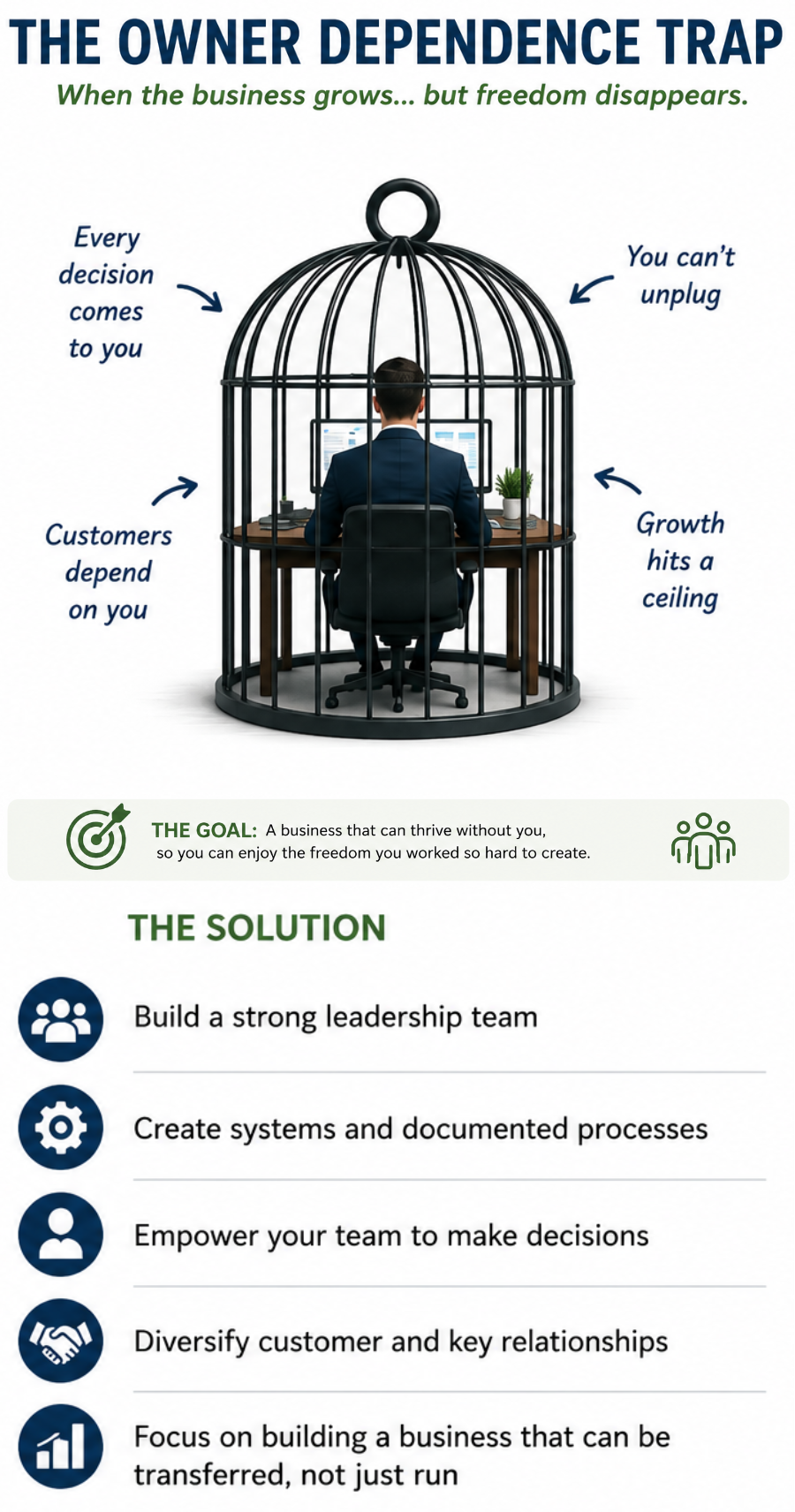
The hidden cost of owner dependence
A business that depends too heavily on the owner often creates:
- operational bottlenecks
- leadership limitations
- increased stress
- slower growth
- lower transferable value
And ironically, the more successful the business becomes, the more trapped the owner can feel.
Because the business may be growing… while freedom is shrinking.
One of the simplest ways to test owner dependence is to ask this question:
If you stepped away for 30 days, what would happen?
Would the business continue moving forward confidently?
Or would key decisions, customer relationships, and operations begin to stall?
Most owners already know the answer.
Why this matters beyond the business
Owner dependence doesn’t just impact operations — it impacts value.
A business that relies heavily on one person becomes harder to scale, harder to transfer, and often harder to sell. Buyers pay for businesses that can operate and grow without constant owner involvement. But even beyond valuation, reducing owner dependence creates something many owners desperately need:
margin.
Margin to think strategically.
Margin to spend time with family.
Margin to step away occasionally without anxiety.
That’s not weakness. That’s maturity.
The goal isn’t removing yourself completely
This doesn’t mean the owner becomes unnecessary.
Great businesses still need strong leadership.
The goal is simply to build a company where:
- decisions are shared
- systems are repeatable
- leaders are developed
- relationships extend beyond the owner
In other words, a business that becomes bigger than one person.
Key Takeaways…
- Owner dependence quietly limits both freedom and business value.
- A business that cannot function without the owner creates stress, bottlenecks, and risk.
- Reducing owner dependence isn’t about stepping away completely — it’s about building a healthier, stronger company.
A simple question to consider
If you disappeared for 30 days… what part of the business would hold up just fine — and what part would start to crack?
That question alone can reveal a lot.
If you’d like to explore the full From Success to Significance series, you can find all the articles here.
Bob Fincher
CEPA, Financial Advisor – Southeast Retirement Planners